03 Hardware + cloud built · demo 2026
Biometric E-Voting Machine
Fingerprint-secured ballot terminal with live cloud tallies
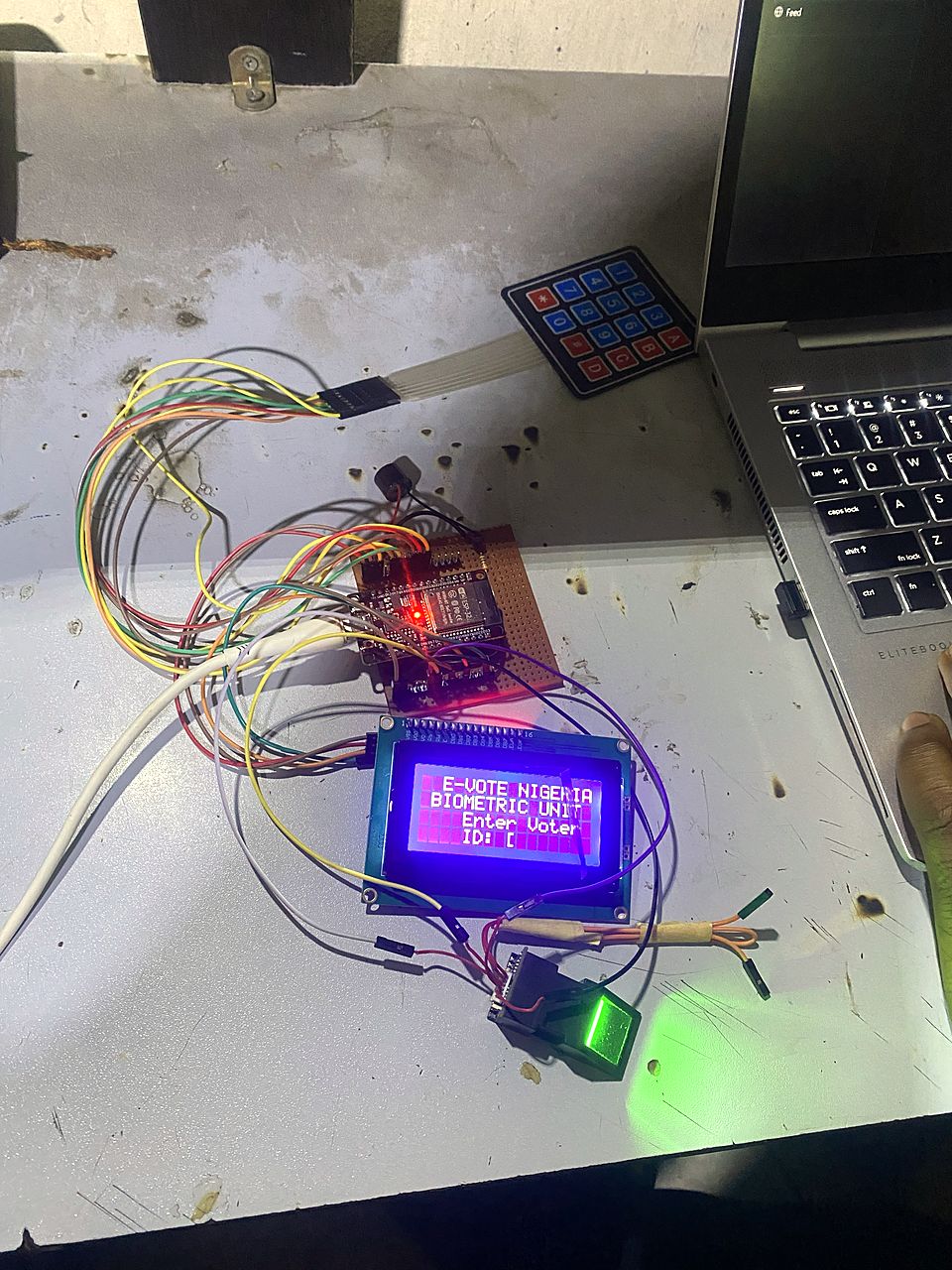
An ESP32 voting terminal that puts 20 party choices behind an AS608 optical fingerprint gate, paginated on a 16×4 LCD with a 4×4 keypad. Every verified ballot is pushed over Wi-Fi to a Render-hosted dashboard on Neon PostgreSQL. Brownout-resist power sequencing keeps optical scans stable mid-read.
- Role
- Hardware & firmware engineer
- Stack
- ESP32 · AS608 · 16×4 LCD · Neon Postgres · Render
- Headline
- 20: Party choices · live cloud sync
A biometric voting terminal: one ESP32, one voter at a time. A vote only exists after an AS608 optical fingerprint match. Twenty political party choices sit behind a paginated 16×4 LCD and 4×4 keypad, and every verified ballot is pushed over Wi-Fi to a Render-hosted dashboard backed by Neon PostgreSQL, so the tally updates live while voting is still happening.
- Why biometric
- One fingerprint, one vote. The module's template matching is the eligibility gate, and it works offline.
- Why the cloud
- Collation is where paper systems fail. Writing each ballot straight to a hosted database removes the transcription step entirely.
- The hard part
- Not the voting logic. It was keeping an optical scanner alive on the same rail as Wi-Fi and an LCD.
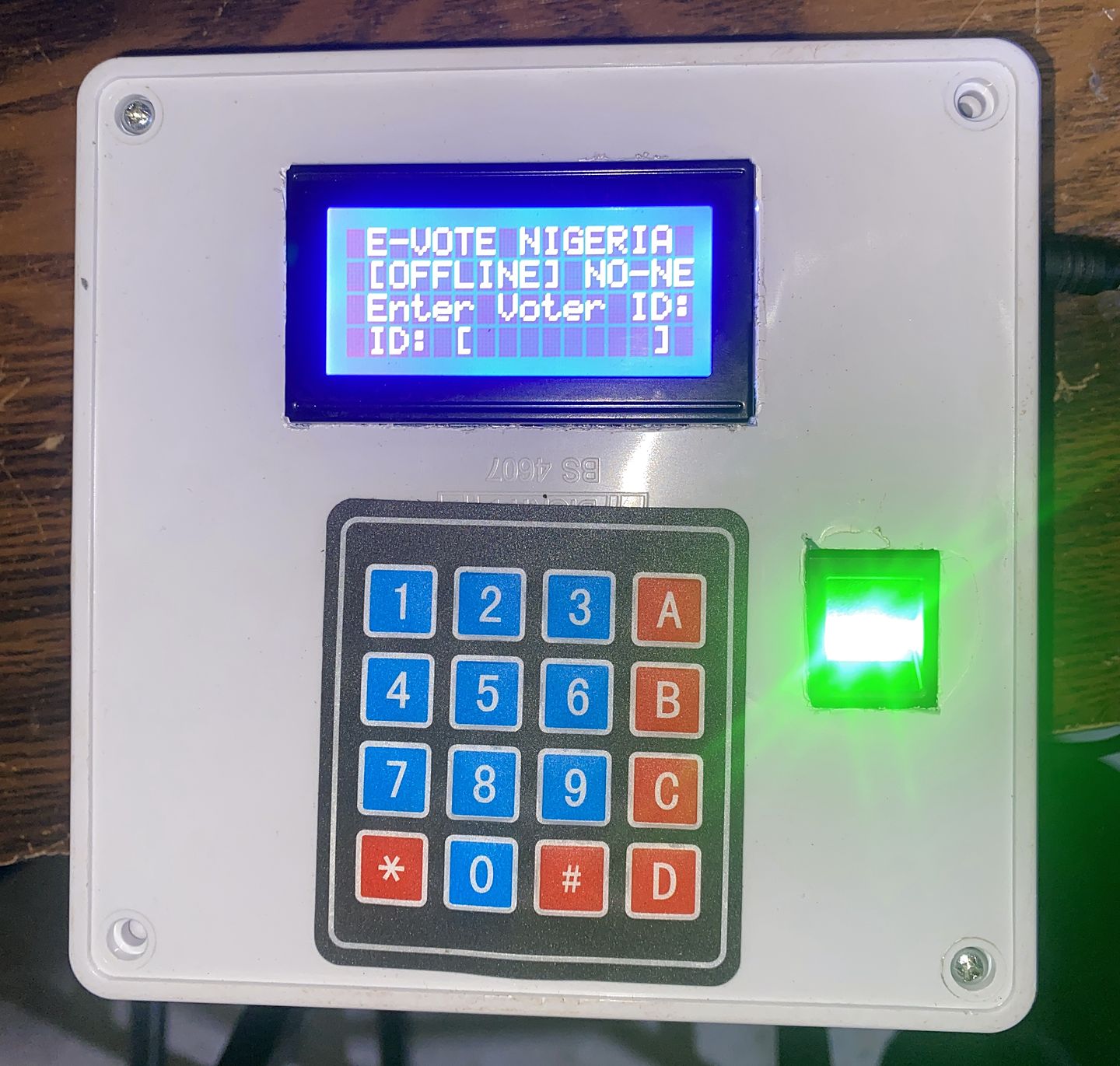
- identifyVoter presents a finger; the AS608 optical module matches against enrolled templates on-module.
- offerTwenty parties, paginated across the 16×4 LCD, four at a time, chosen with the 4×4 keypad. Pagination beats scrolling: the whole option list stays legible at arm's length.
- confirmOne confirm step before the ballot is cast, so a mis-key can be recovered without inviting double-voting.
- recordThe ballot goes out over Wi-Fi to the dashboard; the terminal returns to the identify state immediately.
The state machine is deliberately boring: identify, offer, confirm, record, with one way in and one way out of each state. Election equipment should be dull.
The AS608's optical scan draws a burst of current at exactly the moment the ESP32 is pushing a Wi-Fi frame. On a shared, loosely-decoupled rail the result is a voltage dip during the scan, and the MCU resets mid-ballot. A terminal that reboots while someone is voting is not a prototype problem; it is the whole product failing at its one job.
Fix
Decoupling capacitors placed for the scan's current burst, local charge storage at the sensor so the dip never reaches the ESP32's brownout detector. Scans stopped resetting the board, and the confirm step stopped doubling as a crash reporter.
This project is where power stopped being an afterthought to me: the schematic was fine, the code was fine, and the system still failed until the rail was fixed. I have budgeted decoupling into every build since.
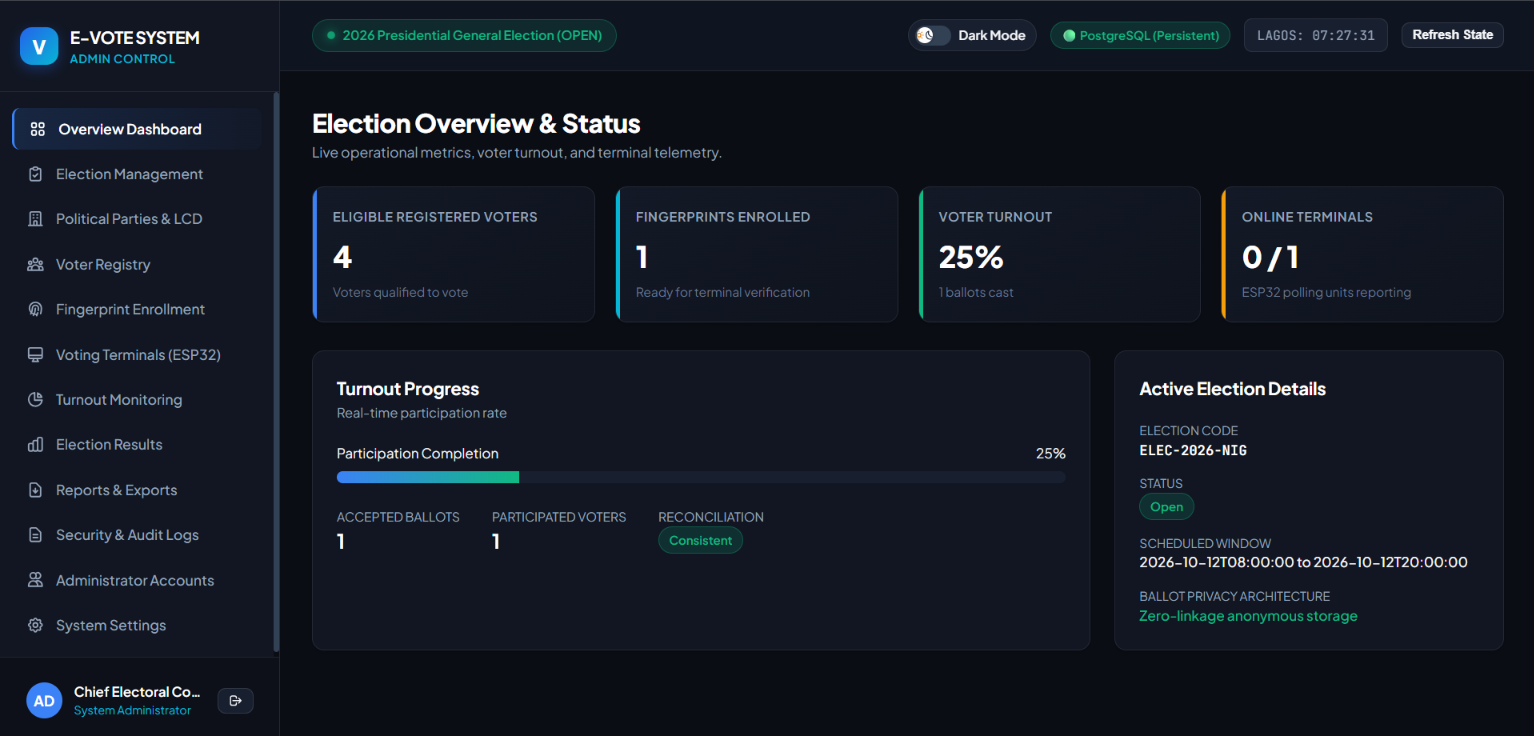
- Terminal → cloud
- Ballots POST from the ESP32 over Wi-Fi, one HTTP request per verified vote.
- Backend
- Neon PostgreSQL (serverless Postgres, free tier) behind a dashboard hosted on Render, also free tier.
- Dashboard
- Live tallies per party, updating as votes land; the collation centre reads the same table the terminal writes.
The whole pipeline runs on free tiers, end to end. That constraint shaped the design in useful ways: one request per ballot, no streaming sockets to hold open, and a schema simple enough to read at a glance.
20
Party choices behind fingerprint + keypad, paginated
0
Resets during optical scans after the decoupling fix
2
Free-tier services carrying the live tally (Neon, Render)
demo
Status: working demonstration build, not fielded equipment
Honest scope: this is a working demonstration of the architecture (biometric gate, paginated ballot, live cloud tally), not certified election equipment. What it proves is the part I own: hardware bring-up, power design, and a firmware state machine that treats a reboot mid-ballot as a defect.
— end of case study —